Private Zermatt Walking Tour: Inside the Old Hinterdorf Quarter (Full Review)
Most visitors arrive in Zermatt, photograph the Matterhorn, and head straight up a mountain railway — missing the village entirely. That is a mistake. Tucked just behind the main shopping street lies the Hinterdorf, the original old quarter where timber granaries on stone stilts have stood for three to five centuries, and where the story of how a poor farming community became the cradle of modern mountaineering is written into the lanes. A private zermatt walking tour is the easiest way to actually understand the place you came all this way to see. This two-hour guided walk is low-altitude, gentle, and entirely paced to your group — a calm, human-scale counterpoint to the cable cars and cogwheel trains. If you are still deciding how to spend your first afternoon, browse all the things to do in Zermatt first, but for most first-timers this walk is the right way to begin.
About This Activity
A local guide just for your group — no strangers, no fixed script
An easy, relaxed pace through the village centre and old quarter
Centuries-old timber granaries raised on stone discs to keep out mice
Guide leads you to the prime Matterhorn and old-village viewpoints
The story of the 1865 first ascent of the Matterhorn, told on the spot
Flat, gentle walking in the village — no climbing, no thin air
Check Live Availability & Prices
Because this is a fully private tour with a dedicated local guide, slots are limited and timing is flexible to your schedule. Check the live calendar for open dates and start times that fit your trip.
Why Walk Zermatt's Old Village With a Private Guide
What this tour actually is
This is a two-hour private guided walk through Zermatt — the village, its main square, and above all the historic Hinterdorf, the old quarter that most day-trippers never find. It is not a mountain excursion. There is no cable car, no summit, no glacier.
The entire route stays at village level, roughly 1,600 metres, on flat lanes you could walk in everyday shoes. What you get instead is context: the human story behind one of the most famous mountains on earth, delivered by a guide who lives in the valley and tailors the walk to your group alone.
From farming hamlet to mountaineering legend
Zermatt was, for most of its history, a remote and rather poor alpine farming community — a cluster of timber barns, granaries and stables wedged at the head of a dead-end valley. Everything changed on 14 July 1865, when Edward Whymper led the first successful ascent of the Matterhorn. Four of the seven climbers died on the descent when a rope snapped, and the tragedy made headlines across Europe.
Almost overnight, Zermatt was transformed from an obscure hamlet into the spiritual home of mountaineering. A good guide walks you through that pivot — standing in the very streets where the climbers lodged and the news first broke.
Why a guided walk beats wandering on your own
You can stroll Zermatt's lanes alone, and many people do. But without a guide the old granaries look like quaint wooden sheds rather than 400-year-old structures, the cemetery is just a churchyard, and the best photo angles stay hidden behind side streets. A private guide connects the dots, answers your questions, and adjusts the pace and emphasis — more history, more photography, or more local life — to what your group actually cares about.
What You'll See on the Walk
The highlights of the route
Over two relaxed hours the walk typically takes in the village's most meaningful spots:
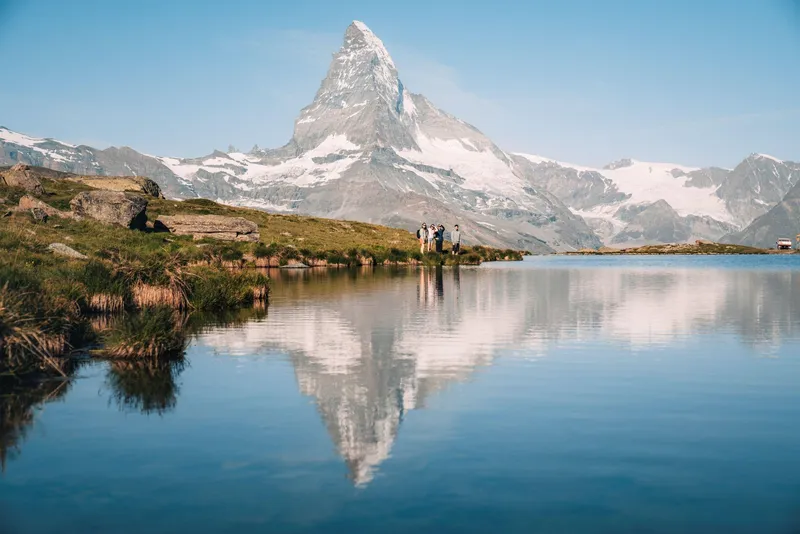
- The Hinterdorf timber granaries — weathered larch-wood storehouses raised on stone discs ("Mausplatten") that stopped mice from climbing into the grain; some date back three to five centuries - The church square (Kirchplatz) — the heart of the village, around the parish church of St. Mauritius - The mountaineers' cemetery — the moving churchyard where climbers who died on the Matterhorn and surrounding peaks are buried, including victims of the 1865 first ascent - The Matterhorn Museum area — the Zermatlantis quarter where the broken rope from 1865 and the village's alpine history are preserved - The best Matterhorn photo spots — the angles down side lanes and along the river where the peak frames perfectly above the rooftops - Bahnhofstrasse — the lively, car-free main street, with context on why Zermatt has banned combustion vehicles for decades
What Is Included — and What Is Not
Included in the tour price
- A private, English-speaking local guide for the full two hours - A personalised walking route through the village centre and old Hinterdorf quarter - On-the-spot commentary on Zermatt's history, alpine culture and the 1865 Matterhorn first ascent - Guidance to the best photo viewpoints for the Matterhorn and old village - Flexible start time and pace arranged for your group alone
Not included — plan for these
- Entry to the Matterhorn Museum (Zermatlantis) — the walk passes it, but admission is paid separately if you want to go in - Food and drinks — no café stop is built into the standard route, though your guide can recommend or include one - Gratuity for your guide — not required, but appreciated for a well-run private tour - Cable car, cogwheel train or any mountain transport — this is a village-level walk only - Hotel pick-up — the tour starts at an agreed meeting point in the village
What Happens on This Tour — Step by Step
-
0:00
Meet your guide near the village centre
Introductions at the agreed meeting point close to the train station and Bahnhofstrasse. Your guide outlines the route and asks what interests your group most — history, photography or local life — then tailors the walk accordingly.
-
0:15
Bahnhofstrasse and the car-free village
Stroll the lively main street and learn why Zermatt has been free of combustion engines for decades, served only by electric taxis and horse-drawn carts. Context on how the village grew after 1865.
-
0:35
Kirchplatz and the church of St. Mauritius
Reach the central square around the parish church — the social and spiritual heart of old Zermatt. Stories of village life, festivals and how faith and mountaineering intertwine here.
-
0:55
The mountaineers' cemetery
A quiet, moving stop at the churchyard where climbers lost on the Matterhorn and neighbouring peaks are buried, including those who died on the descent of the 1865 first ascent. Your guide tells the human stories behind the headstones.
-
1:15
The Hinterdorf old quarter
Step into the original village: timber granaries on stone-disc stilts, narrow lanes and barns three to five centuries old. The walk's centrepiece, and the part almost no day-tripper finds alone.
-
1:40
Matterhorn Museum area and best photo spots
Pass the Zermatlantis museum quarter, where the broken 1865 rope is kept, then on to the river and side-lane viewpoints where the Matterhorn frames perfectly. Time to take your photographs.
-
2:00
Walk ends back in the village centre
The tour finishes near where it began. Your guide leaves you with restaurant tips and ideas for the rest of your stay — Gornergrat, Glacier Paradise or a longer hike.
Important Things to Know Before You Go
What to bring
- Comfortable walking shoes — the route is flat and easy, but you are on your feet for two hours on cobbled and uneven village lanes - A camera or phone — this walk is built around the best photo spots for the Matterhorn and old village; bring something better than a bad lens - Layers — Zermatt sits at 1,600 metres and mountain weather shifts fast; mornings and shade can be cool even in summer, so a light jacket or fleece is wise - Water and sun protection — alpine sun is strong; a hat and sunscreen help on bright days - A little cash — for an optional café stop, museum entry or a gratuity for your guide
Etiquette and a few things to leave behind
- Respect the cemetery — the mountaineers' churchyard is an active, sacred place; keep your voice low and avoid posing for casual photos among the graves - Don't touch or lean on the granaries — the old Hinterdorf structures are protected heritage and centuries old - No need for hiking poles or heavy gear — this is a gentle village walk, not a mountain hike; leave the trekking equipment at the hotel - Flexible timing — because the tour is fully private, start time and emphasis can be adjusted; just agree it with your guide in advance rather than on the day - Mind the electric taxis and carts — Bahnhofstrasse is car-free but not vehicle-free; the silent electric taxis are easy to miss
Where the Walking Tour Takes Place
Who This Tour Is For
Ideal guests
- First-time visitors to Zermatt who want to understand the village before heading up the mountains - History and culture lovers drawn to the 1865 Matterhorn story and the birth of modern mountaineering - Photographers who want a local to lead them straight to the best Matterhorn and old-village angles - Couples, families and small groups who value a private, flexible, personalised pace over a fixed group tour - Travellers with limited mobility for high-altitude activity — this low, flat, easy walk delivers Zermatt's atmosphere without any climbing or thin air - Anyone with a spare half-day between cable-car excursions looking for a calm, meaningful village experience
Not suitable for
- Adventure-seekers wanting high-mountain action — this is a village walk; for summits, glaciers or paragliding, the mountain tours suit you far better - Visitors on a very tight schedule who only have an hour and would rather spend it on a cable car to a viewpoint - Travellers looking for the cheapest possible activity — a private guide for your group alone is a premium, not a budget, option - Those expecting big-group socialising — the private format is intimate by design, not a way to meet other travellers
How long and how physically demanding is the walking tour?
The tour lasts about two hours and is genuinely easy. The entire route stays at village level around 1,600 metres on flat, gentle lanes — there is no climbing, no altitude exposure and no steep ground. As long as you are comfortable walking slowly on cobbled streets for two hours, you will be fine. It is one of the most accessible ways to experience Zermatt.
Is this tour really private, just for my group?
Yes. You get a local guide dedicated to your group alone — no strangers join. That means the route, the pace, the start time and the emphasis can all be tailored to what you want, whether that is more history, more photography or simply a relaxed amble. It is the main reason this walk feels so personal compared with a fixed group tour.
What will I actually see on the walk?
The highlights are the old Hinterdorf quarter with its centuries-old timber granaries on stone-disc stilts, the church square and parish church, the mountaineers' cemetery, the Matterhorn Museum area, the car-free Bahnhofstrasse, and the best photo viewpoints for the Matterhorn. Your guide ties them together with the story of how Zermatt grew from a farming hamlet into a mountaineering legend after the 1865 first ascent.
Does the price include the Matterhorn Museum or any mountain transport?
No. The tour covers the private guide and the village walk itself. Entry to the Matterhorn Museum (Zermatlantis) is paid separately if you want to go inside, and no cable car or cogwheel train is included — this is a village-level walk, not a mountain excursion. Your guide can advise on adding those before or after.
Is this a good first activity when arriving in Zermatt?
It is ideal. Arriving travellers often rush straight onto a mountain railway and never understand the village they came to see. A walking tour first gives you the history, layout and context, so the rest of your trip — Gornergrat, Glacier Paradise or a hike — makes far more sense. It also works well as a gentle activity on a day when the high peaks are clouded in.
What Guests Say
We did this on our first afternoon and it changed how we saw the rest of our stay. Our guide took us into the old Hinterdorf, which we never would have found alone, and the story of the 1865 climb told right there in the streets gave me goosebumps. Easy, relaxed and genuinely fascinating.
As a private tour it was worth every franc. Just my parents and me, no big group, and our guide adapted everything to us — extra time at the cemetery and the old granaries, then straight to the best photo spots for the Matterhorn. My father has a bad knee and the flat, gentle walk suited him perfectly.
I almost skipped the village for another cable car and I'm so glad I didn't. Two hours, no rush, real local knowledge. Those wooden granaries look like nothing until someone explains them. The mountaineers' cemetery was unexpectedly moving — the best two hours of our week in Zermatt.